One node, any scale
A part with no operating system writes a record into its own flash and reads it back by its address after a reset.
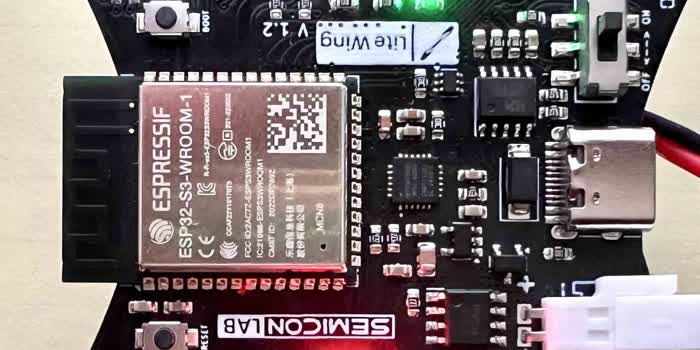
The smallest host in the claim: a microcontroller with no operating system, 8 MB of flash and 64 kB of working memory, writing a record that survives a reset. The same build runs on every host above it, and a deployment can be a field of these nodes.
What the board reported
| Over the RAM medium | Over the flash region | |
|---|---|---|
| Heap peak | 2,384 B | 1,648 B |
| Arena | 65,552 B | 65,552 B |
| Medium | The engine's own map in RAM | A 2 MiB partition at 0x130000 |
| Records | Two written and walked back in one boot | Three from three earlier boots, each reached by its coordinate after a reset |
| Application | 356,576 B in a 1 MiB slot | 447,968 B |
| Bootloader | Untouched | Untouched |
The flash run peaks lower than the RAM run because the region channel holds no map in memory. That is the same trade the host measurements show from the other side: the path that keeps nothing per record is the path that answers by reading the log.
What the board printed
The table above is the board's own console output, with each coordinate written in the engine's ASCII form. The first run kept its records in the engine's RAM medium; the second kept them in the flash partition and read them back after each reset.
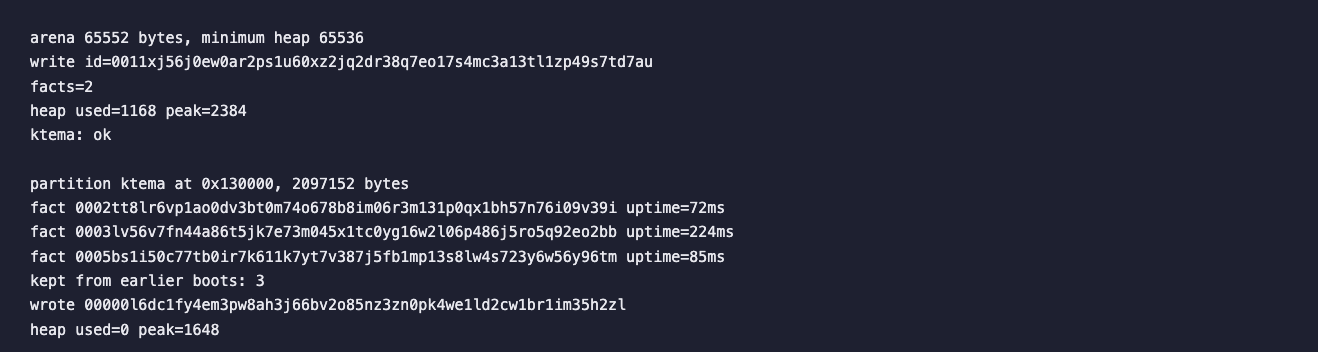
arena 65552 bytes, minimum heap 65536
write id=0011xj56j0ew0ar2ps1u60xz2jq2dr38q7eo17s4mc3a13tl1zp49s7td7au
facts=2
heap used=1168 peak=2384
ktema: ok


partition ktema at 0x130000, 2097152 bytes
fact 0002tt8lr6vp1ao0dv3bt0m74o678b8im06r3m131p0qx1bh57n76i09v39i uptime=72ms
fact 0003lv56v7fn44a86t5jk7e73m045x1tc0yg16w2l06p486j5ro5q92eo2bb uptime=224ms
fact 0005bs1i50c77tb0ir7k611k7yt7v387j5fb1mp13s8lw4s723y6w56y96tm uptime=85ms
kept from earlier boots: 3
wrote 00000l6dc1fy4em3pw8ah3j66bv2o85nz3zn0pk4we1ld2cw1br1im35h2zl
heap used=0 peak=1648
The surface the firmware links
A part like this has a flash region, a write, and an erase. It has no key-value medium, so the C surface takes that shape rather than a layout: the region as a slice the engine can read, and two callbacks for the writes and the erases that the driver owns.
The region channel sits above it and carries the log, the segment index, the forward-only write rule, and the recovery of a torn tail. The firmware writes no format and keeps no index of its own, which is why the same application runs unchanged here and on the host.
What the board does not cover yet
Two cases are modelled against a slice and have not run on a part: a power cut in the middle of a write, and a region that has filled and retired its oldest segment. Until both run on the board, the durability claim covers the reopen that the run above performs, and does not cover those two.